
Melvor Idle 2 Combat Guide: Stances, Food and Death
How Melvor Idle 2 combat works in Early Access: style choice, accuracy, food timing, death cost and the first upgrades that matter.
Combat in Melvor Idle 2 is a preparation test disguised as an idle activity. The fight itself resolves without inputs, so the decisions that matter happen before you press start: which style, which food, which gear, and whether the expected loot pays for the attempt.
The sequel keeps the familiar idle loop but adds new combat mechanics and reworked mastery. That makes copied first-game builds unreliable. The stable approach is to understand the variables, then test against content you can afford to fail.
The three decisions
| Decision | What it controls | Default for a new account |
|---|---|---|
| Combat style | Which accuracy and damage stats apply | Melee, because early gear is craftable |
| Food policy | How long you can stay in a fight | Highest healing food you can replace |
| Upgrade order | How fast the next fight goes | Weapon, then body, then legs |
Style choice is not permanent, but it is expensive to undo early. Pick the style your Smithing chain can arm. If you cannot make a weapon for it, you are dependent on drops, and drops are not a plan.
Accuracy before damage
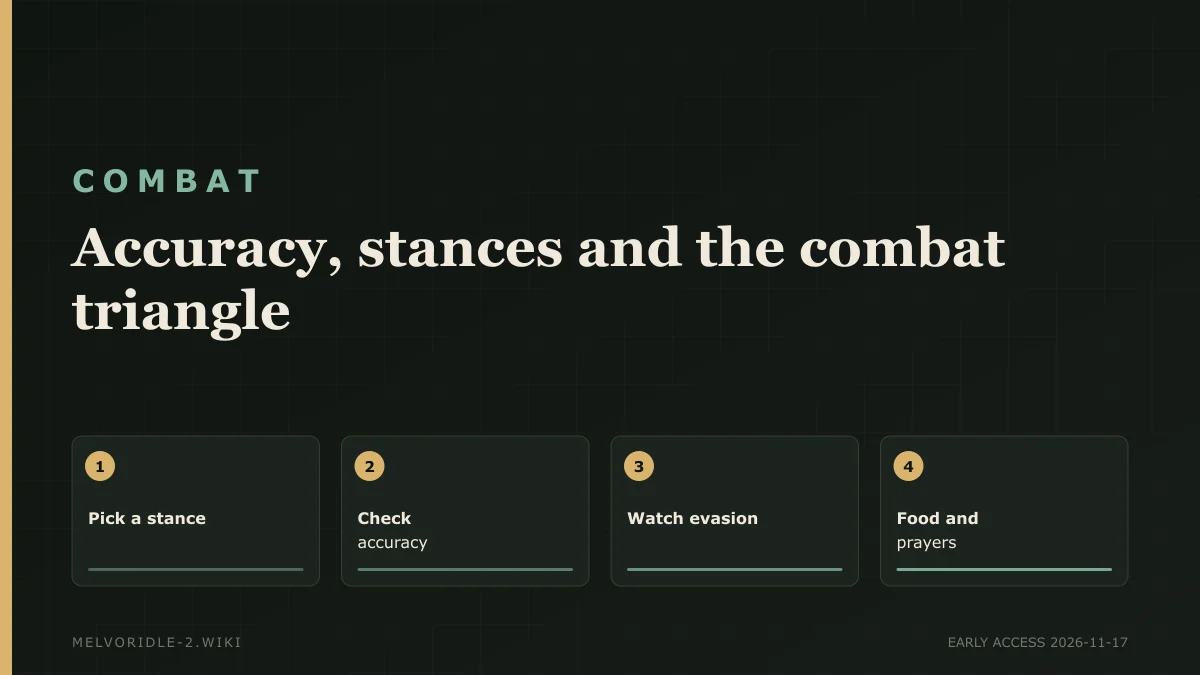
A miss does zero damage and still consumes time. That makes accuracy the first stat to fix on any new monster. If your hits are landing reliably, add damage; if they are not, add accuracy or move down a tier.
The practical test is a short run, not a spreadsheet:
- Fight the target for a fixed number of kills.
- Note whether you run out of food before the target dies.
- If food is the limit, improve accuracy or defence.
- If time is the limit and food is stable, improve damage.
Change one item or one food tier per test. Changing three things at once tells you that something worked, not what worked.
Food timing and overkill
Auto-eat triggers at a threshold, not at zero. That means the last hit can land after your food is gone, and a fight you were winning becomes a death. The fix is to enter hard content with more food than the expected damage requires, not exactly enough.
Overheal is not wasted if it prevents one death. A death costs the run, the food and the time; an extra food slot costs inventory space.
Death and the cost of a run
The sequel's death penalty follows the first game's shape: you lose the run's progress and the consumables you brought. That makes every attempt a budget. Before a boss or dungeon, price the attempt:
- Food stacks consumed on a failed run
- Potions consumed
- Time to re-farm the food
- Whether the drop you want is worth more than three attempts
If the answer is no, the content is a gear check, not a farming spot.
Use the gear you can replace. A successful test with irreplaceable gear teaches you nothing about whether the strategy is sustainable.
First upgrades that matter
- Weapon tier. Clear speed is the biggest lever.
- Body armour. Survivability buys time for accuracy to work.
- Food tier. Higher healing per slot means longer runs.
- Prayer or potion buffs. Percentage multipliers, but only after the base gear is stable.
Do not buy cosmetic or convenience upgrades before these four. The equipment guide→ covers slot-by-slot choices, and the combat leveling page→ covers where to train.
Style-specific notes
Melee is the default because ore and bars are predictable. It is also the most food-hungry early, so keep Cooking level with it.
Ranged needs ammo or a comparable consumable, which adds a second production chain. Strong once funded, expensive as a first style.
Magic needs runes and a magic weapon. It scales well with Herblore and Prayer, but the setup cost is the highest of the three.
The combat triangle still matters, but do not over-rotate. A well-fed melee account clears more than a poorly funded magic account.
FAQ
Can I idle combat safely? Yes, if your food and gear are above the target's expected damage. Idling a fight you would lose manually just loses it slower.
Should I train all three styles? Not early. Train one to a stable gear tier, then level the others with the same food budget.
Does gear matter more than levels? They multiply. A level-appropriate weapon with appropriate levels beats a high-level weapon you cannot support with food.
What should I do after a death? Drop one tier, fix the limiting variable, and re-test. Do not repeat the same attempt with the same budget.
Official source: Melvor Idle 2 on Steam ↗ Official source: Early Access announcement ↗ Community source: Melvor Idle wiki combat guides ↗